
Designing the organizational layer that makes HR automation possible
lead designer
·
organizational abstraction
JAN 2026
Overview
Organizational structures are rarely simple. Companies needed a flexible way to represent reporting lines without increasing setup complexity. The challenge was to simplify a highly configurable system while preserving the flexibility enterprise customers relied on.
The challenge
The existing experience reflected the complexity of the underlying data model rather than the mental model of HR teams. Users were forced to think about the system instead of their organization.
Through product workshops, customer interviews, and support insights, we identified three recurring problems:
Companies struggled to represent their real organizational structure.
Manual setup became increasingly difficult as organizations grew.
The experience lacked scalability for enterprises with thousands of employees.
That structure became the Job Catalog: a three-tier hierarchy of Families → Functions → Roles, with an inheritance system that flows configuration downward automatically.
The solution wasn't a better form. It was a missing layer of abstraction.
approach
Rather than redesigning the interface, I focused on understanding how organizations actually model their teams. Working closely with Product and Engineering, we identified common patterns and designed a scalable system that reduced complexity without limiting customization.

THE CHALLENGE: making inheritance legible
Inheritance is the most powerful concept in the catalog — and the hardest to communicate. When an HR manager assigns a salary band to a Marketing family, it propagates to every function and role inside it, including future ones.
The side panel surfaces all inherited attributes in one glance — working conditions, salary ranges, competencies, devices — without navigating away. It answers the question every user has: where does this come from, and who does it affect?
The full page separates configuration from insight. Each node has tabbed views for working conditions, competencies, devices, and salaries — but also a People analytics view showing gender distribution, salary ranges across subfunctions, and headcount.
The catalog isn't just setup infrastructure. Once configured, it makes the org legible.


Where the SOLUTION failed first
After beta, onboarding specialists reported CSV import was generating errors. The real issue: users hadn't internalized the Family → Function → Role model before trying to populate it. They were skipping parent rows, assuming the system would infer them. The CSV surfaced a mental model problem, not a usability problem.
giving context and flexibility to increse adoption
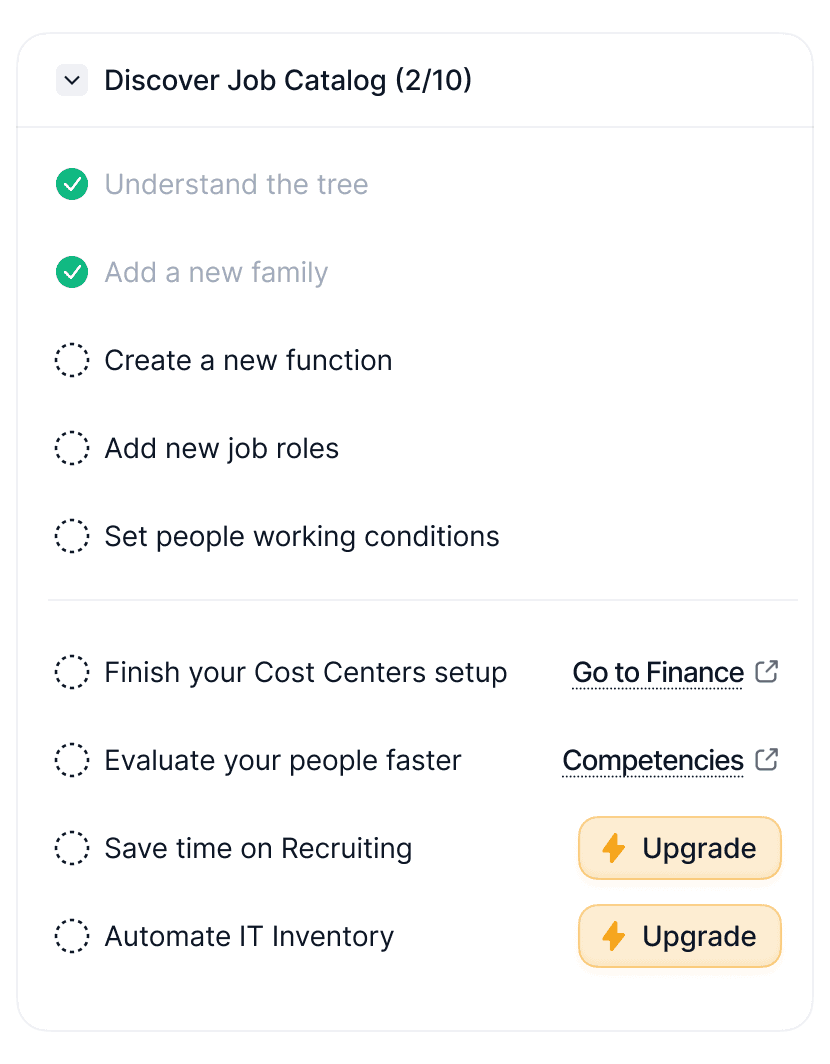
We introduced a contextual setup guide alongside the graph — guiding users through first setup in order: understand the tree → create a family → add functions → configure conditions. It also surfaces cross-product connections and upgrade prompts. Goal: activate value, not explain UI.
Companies reorganize. Functions change departments. The catalog needed to evolve with the org without requiring a full rebuild. Nodes can be moved between families and functions directly on the graph. After feedback from our beta testers, we decided to invest on a drag and drop function that allow easy movement between nodes structure.
23% → 71%
Catalog setup completion rate after guided checklist

What it enabled
For companies that completed setup, the catalog collapsed the cost of recurring HR operations.
- 65%
time setting up performance reviews
- 56% (7min to 3min)
Reduction in time to onboard employees

collaboration
This project required close collaboration across Product, Engineering, Customer Success, and HR specialists.
Many design decisions were driven by technical limitations, implementation costs, and customer feedback rather than visual preferences.
Balancing those perspectives was as important as designing the interface itself.
outcome
The redesigned experience significantly reduced the effort required to configure organizational structures while making the product more approachable for both new and enterprise customers.
The three-tier structure works well for large companies with formal org design. For smaller companies with less defined hierarchies, the catalog creates friction rather than removing it — the setup cost outweighs the automation benefit.
The next design challenge is a simplified mode for SMBs: the same automation, without requiring a formal org structure to unlock it.